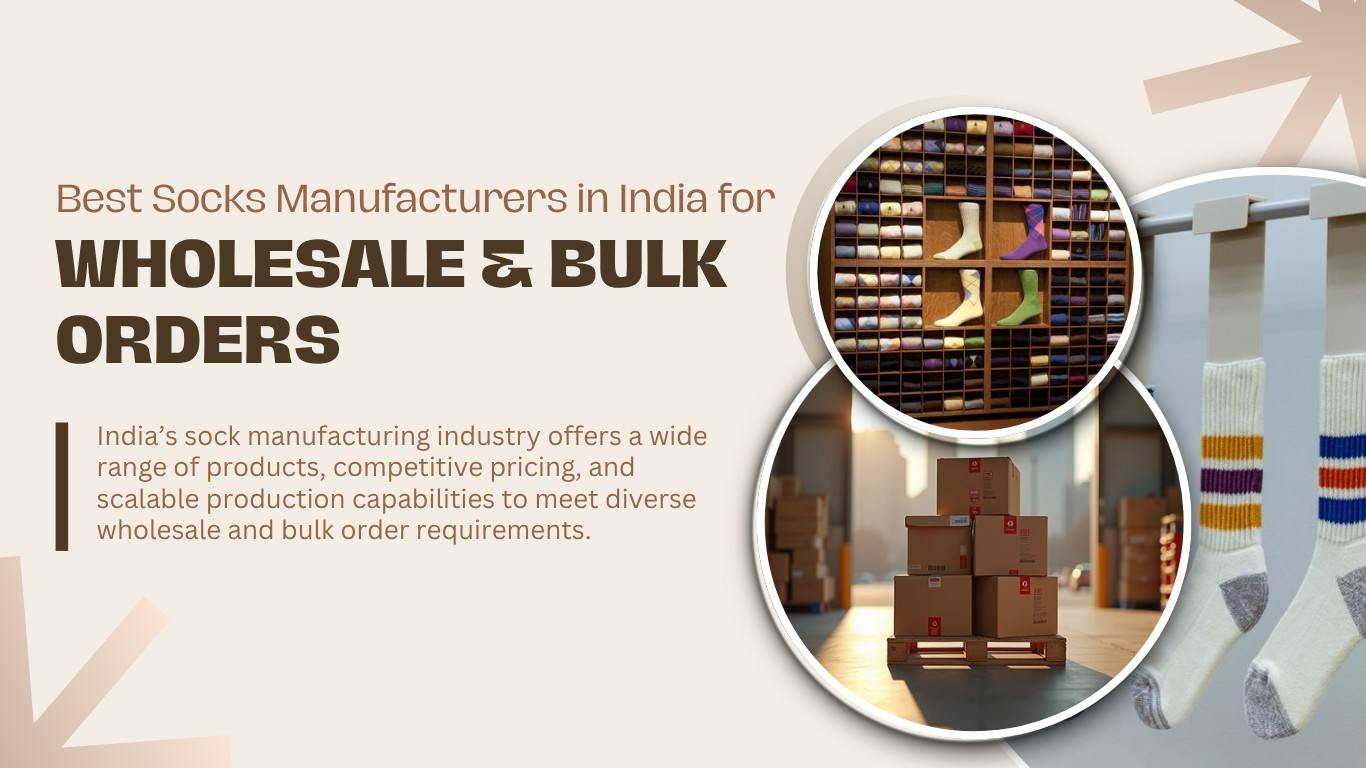
Nowadays organic socks manufacturers are focusing on becoming key partners for retailers, wholesalers and private label brands. They want to provide top-notch quality products that are sustainable without sacrificing on quality, comfort or profit margins. India has decades of experience in exporting goods and has availability of organic cotton and knitting clusters in Tiruppur, Ludhiana and Kolkata, thus making it one of the best sourcing countries. Businesses can benefit from competitive pricing, greater visibility over the supply chain and more control over product quality and customisation by going direct to Indian manufacturers.
In this blog, we’ll walk you through ten practical steps to sourcing organic cotton socks directly from Indian manufacturers.
Table of Contents
Toggle1. Identify Certified Organic Cotton Sock Manufacturers
Begin with factories, not middlemen. Look for units that do their own knitting, linking, finishing and packing. When you are looking at organic socks, manufacturers must assure that they have their own organic production line or at least a strict separation between their organic and conventional materials. Trade directories, export promotion councils, sourcing platforms and textile fairs are all good places to begin to build a shortlist. Ask each one to provide a company profile, photos of their factory and references from their existing export clients.
2. Verify GOTS and Other Relevant Certifications
Certification is a proof of authenticity. The most recognised certification is GOTS – Global Organic Textile Standard, while OCS – Organic Content Standard is also widely used. In addition, there is OEKO-TEX Standard 100, and you may also enquire about a BSCI/SEDEX audit for social compliance. However, do not depend solely on the document in PDF format. The certificate number should be checked against the list of certifying companies.
3. Check Yarn Composition and Organic Cotton Quality
Socks are never made of 100% cotton. Mostly, they contain polyamide or nylon for strength and elastane for elasticity; hence, you need to request the percentage composition of the fabric. Transaction certificates for organic yarns are also needed along with yarn counts, ply and spinner details. Renowned organic sock manufacturers in India can trace their yarn all the way back to spinning mills and the cotton source, and they will definitely want to disclose all such essential information without any hesitation.
4. Request Samples Before Placing Bulk Orders
Never place an order based only on the catalogue. Instead, request pre-production samples in the selected size, fit and design. Check the samples for shrinkage, colour fastness, elasticity, durability of heels/toes and laundering results. Compare the samples with your tech pack and be ready to have one or two rounds of corrections done.
5. Confirm MOQ and Bulk Pricing
MOQs differ greatly depending on individual factories. Some factories may require 3,000 pairs of socks per design, while others may require 10,000 pairs or more. The MOQ will be dependent upon the type of yarn used, as well as the complexity of the design. Request a breakdown of the pricing structure to make sure the prices are transparent for the yarn, knitting, dyeing, labelling, packaging, and testing. Also, make sure to understand the pricing structure at various volumes and whether it is quoted Ex-Works, FOB, or CIF. Beware of prices far below the average market price, as these often signify blended or non-certified material.
6. Evaluate Manufacturing Capacity and Lead Times
The factory should be able to process your orders without any compromise in terms of quality. Ask for the number of knitting machines in the factory, the production capacity of the factory on a daily basis, the capacity for dyeing and the load of the factory in peak seasons. The normal delivery time frame of organics is between 45 days and 75 days after the approval of samples.
7. Verify Dyeing, Processing and Chemical Compliance
It is important to note that poor processing could also have a negative impact on the quality of organic fibres. Check that the dyes and chemicals used meet the specifications set forth in the GOTS guidelines and find out whether waste water is treated in an effluent treatment facility. Testing reports for restricted substances, azo dyes, and formaldehyde are required.
8. Discuss Custom Designs and Private-Label Options
Most renowned organic sock manufacturers in India provide bespoke services such as: Jacquard printing, Ribbing, Cushioning, Logo, Woven Tags, Hang Tags and Eco Packaging. Remember to send through your Tech Pack, Pantone Swatches and Size Charts. If you are designing your own private label range then make sure your designs can’t be used by anyone else.
9. Check Export Documentation and Shipping Capabilities
Having the correct documentation in place will ensure a smooth export process. Confirm the manufacturer has an active Import Export Code (IEC), they have the correct procedures in place for commercial invoice, packing list, certificates of origin and certification transaction documents. Ask about their experience in your destination country, what freight forwarders they work with, and what type of transport they use. Do they use air/sea for smaller orders? What are the packaging and labelling requirements? Do they have care labels, country of origin and GOTS labelling?
10. Finalise Quality Standards, Payment Terms and Delivery Schedules
Document everything prior to the processing. Agree on AQL standards, defects, third party inspections and what to do with products that are not up to scratch. Set down in writing the payment terms such as initial payment and the remainder paid against the bill of lading or letter of credit.
Keeping in mind all the pointers would be very helpful in choosing the best organic socks manufacturers in India. Always do a thorough research before placing an order.
FAQs:
1. What should buyers check when sourcing organic cotton socks directly from Indian manufacturers?
Verify authentic certifications, yarn traceability, sample quality, MOQ, price range, manufacturing capability, chemical adherence and export proficiency. Verify them all before placing your bulk order.
2. What certifications should an organic cotton socks manufacturer provide?
GOTS or OCS is essential for organic claims. OEKO-TEX Standard 100 and social compliance audits such as BSCI or SEDEX add further assurance. Always verify certificate numbers with the issuing body.
3. How can international buyers verify quality, MOQ, pricing and export capabilities before placing a bulk order?
Request pre-production samples, a cost breakdown, and test reports. Conduct an audit of the manufacturing facility, either remotely or physically, along with requesting export references and sample shipping documents. After which, finalise the terms in a formal purchase contract.
Request a Quote Today!
Contact Texcyle for custom or private-label sock enquiries. Call us at +91 7982201014 to discuss your requirements.